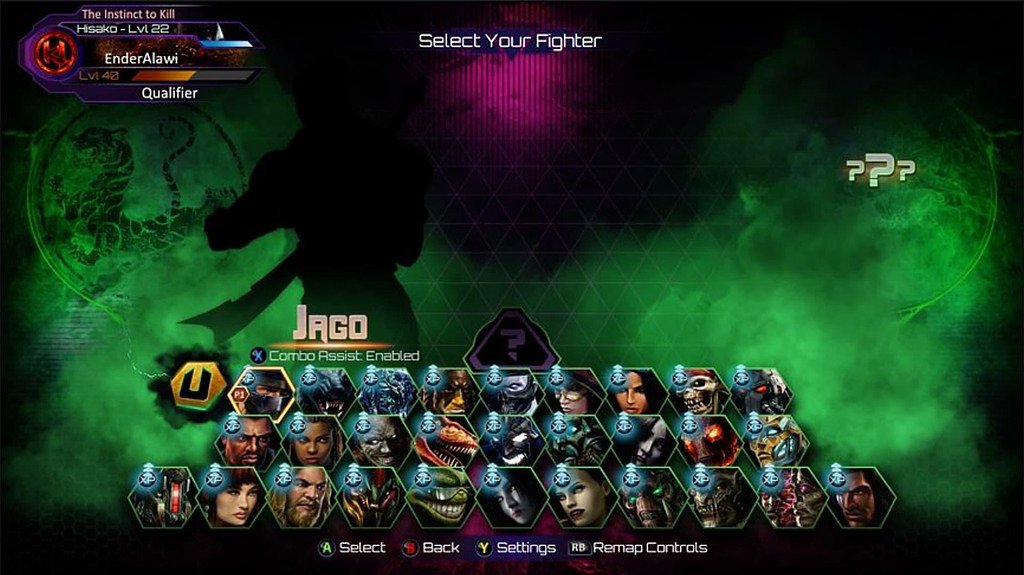
Killer Instinct characters include 29 playable fighters in the modern game, ranging from familiar names such as Jago, Fulgore, Orchid, and Sabrewulf to crossover guests from Halo, Battletoads, and Gears of War. Killer Instinct Anniversary Edition includes the complete modern roster, while the original arcade game and Killer Instinct 2 feature smaller, different lineups.
However, knowing the names is only the beginning. Each fighter changes how you approach a match. Some reward aggressive attacks, others control the screen from a distance, and several require you to manage unusual resources.
If you are struggling to choose a main character, this guide explains the full roster, each fighter’s general strengths, the differences between the classic games, and a practical way to find a character you enjoy.
How Many Characters Are in Killer Instinct?
The modern Killer Instinct roster contains 29 playable characters. The official Killer Instinct website confirms that Anniversary Edition includes all 29 fighters.
The answer becomes more complicated when discussing the entire series because different releases have different character selections.
| Game or edition | Character lineup | What readers should know |
|---|---|---|
| Original Killer Instinct arcade game | 10 standard fighters and boss Eyedol | Boss access differs between versions |
| Killer Instinct 2 | 10 standard fighters and boss Gargos | Introduces Maya, Kim Wu, and Tusk |
| Killer Instinct Gold | Based on the Killer Instinct 2 lineup | The version associated with Nintendo 64 |
| Killer Instinct, released in 2013 | Expanded to 29 playable fighters | Includes returning fighters, newcomers, and guests |
| Killer Instinct Anniversary Edition | All 29 modern fighters | An edition of the modern game rather than a separate sequel |
This distinction matters when following character guides. A strategy written for the original arcade version may not apply to the modern game, even when the character’s name is the same.
Complete Killer Instinct Characters List
The following table covers every playable fighter in the modern roster. These playstyle descriptions provide a starting point rather than a strict limit on what each character can do.
| Character | General playstyle | Main gameplay feature |
|---|---|---|
| Aganos | Armor and positioning | Uses chunks for armor, projectiles, and walls |
| Arbiter | Midrange control and setups | Combines sword attacks, ammunition, and grenades |
| ARIA | Adaptable offense | Switches between bodies with different abilities |
| Cinder | Mobile pressure | Uses aerial movement, bombs, and burnout mechanics |
| Eagle | Assisted offense and zoning | Coordinates arrows with a mechanical bird |
| Eyedol | Alternating rushdown and zoning | Changes between two fighting modes |
| Fulgore | Versatile offense and defense | Manages a reactor-based resource system |
| Gargos | Summons and screen control | Uses minions to support his attacks |
| General RAAM | Close-range grappling | Threatens powerful command grabs |
| Glacius | Long-range control | Restricts movement with ice-based attacks |
| Hisako | Counters and command grabs | Uses Wrath to support her threatening options |
| Jago | Balanced fundamentals | Combines projectiles, anti-air attacks, and grounded offense |
| Kan-Ra | Traps and setups | Controls space with sand and swarms |
| Kilgore | Projectile zoning | Uses guns, missiles, and heat management |
| Kim Wu | Ground control | Combines precise attacks with Dragon resources |
| Maya | Dagger-based pressure | Throws, tracks, and retrieves her daggers |
| Mira | Resource-heavy offense | Spends recoverable health on powerful abilities |
| Omen | Mobile pressure and projectiles | Uses unusual fireballs and extra shadow-meter capacity |
| Orchid | Grounded pressure | Combines strong movement with offensive setups |
| Rash | Mobile aggression | Uses tongue movement and Battletoads-inspired attacks |
| Riptor | Rushdown and movement | Combines running, flames, and Predator stance |
| Sabrewulf | Close-range rushdown | Uses fast movement and sustained pressure |
| Sadira | Aerial offense | Attacks through double jumps and airborne movement |
| Shadow Jago | Mobility and mix-ups | Uses surge-enhanced moves and unusual approaches |
| Shin Hisako | Sword-based pressure | Combines sword attacks with spirit-orb mechanics |
| Spinal | Resource-driven offense | Uses skulls, curses, and teleports |
| Thunder | Grappling | Combines command grabs with damaging attacks |
| TJ Combo | Aggressive close-range offense | Uses boxing attacks and flexible follow-ups |
| Tusk | Midrange control | Controls space with heavy sword attacks |
Understand the Fighting Styles Before Choosing a Character
Character descriptions become much more useful once you understand a few common fighting-game terms.
Rushdown
Rushdown characters try to get close and keep the opponent defending. Their offense may combine quick attacks, throws, movement, and changes in attack direction.
Sabrewulf and Riptor are useful examples. Their goal is often to create repeated defensive decisions rather than give the opponent space to recover.
Zoning
Zoning means controlling parts of the screen with attacks or projectiles.
A zoning character does not simply stand far away and press the same button. Effective zoning involves predicting movement, covering approaches, and knowing when to reposition.
Glacius and Kilgore demonstrate different versions of this approach.
Grappling
Grapplers build their offense around command grabs—special throws that create a different defensive problem from ordinary strikes.
Once an opponent fears being grabbed, they may jump or attack more often. A grappler can then punish those reactions with other tools.
Thunder and General RAAM are clear examples.
Setups and Resource Management
A setup is a prepared situation that creates useful offensive options, often after a knockdown.
Resource management involves tracking something beyond basic health and meter. Maya’s daggers, Spinal’s skulls, and Aganos’s chunks all influence which decisions are available.
These mechanics can be rewarding, but they add another task while you are learning movement, defense, and combos.
Balanced Characters and Ground-Control Specialists

Jago: A Practical Starting Point
Jago provides a clear introduction to the game’s fundamentals. His projectile helps him challenge opponents at a distance, while his uppercut gives him a recognizable answer to jumping attacks.
His grounded offense also makes it possible to begin with a manageable collection of moves.
Choose Jago if you want to understand spacing, defense, and basic combo decisions without immediately learning a highly unusual resource system. The detailed Jago guide explains how his individual tools support that balanced approach.
Fulgore: Flexibility With Resource Decisions
Fulgore combines projectiles, teleports, close-range attacks, and defensive options. This variety allows him to change strategies depending on the opponent.
His reactor system creates an additional learning requirement. You need to understand how your available resources affect the options you can use.
Fulgore suits players who enjoy adapting during a match and want a character with room for long-term experimentation.
Orchid: Movement and Purposeful Pressure
Orchid rewards grounded movement and well-placed attacks. She can challenge opponents around midrange before converting an opening into closer pressure.
Her setup tools provide additional options after a knockdown. This encourages you to think about the next defensive decision instead of immediately repeating the previous attack.
Choose Orchid if you enjoy staying active while maintaining control over your positioning.
Kim Wu: Precise Grounded Combat
Kim Wu is appealing to players who enjoy accurate spacing and punishing missed attacks.
Her Dragon resources add movement and cancel options, giving her more flexibility as your understanding develops.
She is a suitable choice if you prefer making the opponent commit first and responding with a deliberate attack.
Tusk: Reach, Timing, and Heavy Attacks
Tusk’s sword threatens a large area of the screen. His attacks encourage opponents to think carefully before moving into range.
However, reach does not remove the need for timing. Committing to a large attack at the wrong moment can create an opening for the opponent.
Choose Tusk if you enjoy deliberate decisions and controlling the space just outside an opponent’s comfortable reach.
Aggressive and Highly Mobile Fighters
Sabrewulf: Direct Close-Range Offense
Sabrewulf has an easy-to-understand objective: close the distance and apply pressure.
His movement and close-range tools make him appealing to players who want an aggressive starting point. The challenge is learning when to continue attacking and when to respect the opponent’s response.
Repeated aggression becomes predictable, so good Sabrewulf play requires patience as well as speed.
TJ Combo: Boxing With Flexible Follow-Ups
TJ Combo uses a boxing-based moveset supported by multiple special-move follow-ups.
His offense rewards anticipating the opponent’s reaction. A successful approach can lead to different decisions depending on whether the opponent blocks, jumps, or challenges.
He suits players who enjoy making active choices during close-range exchanges.
Riptor: Fast Movement and Stance Pressure
Riptor combines running movement, flame attacks, and Predator stance.
Her tools allow her to move in and out before committing to stronger pressure. Predator stance adds offensive choices that become more useful as you learn their purpose.
Choose Riptor if you enjoy energetic gameplay and can track positioning during fast exchanges.
Sadira: Attacking From the Air
Sadira’s double jump and airborne options allow her to vary her approach more than many grounded fighters.
Her movement can challenge opponents who struggle to defend against attacks from above. Against reliable anti-air defense, you must change your timing rather than repeat the same jump.
Sadira suits players who enjoy aerial movement and practicing juggle combos.
Cinder: Movement With a Longer-Term Plan
Cinder combines unusual movement, projectile pressure, and burnout mechanics.
His offense often involves preparing a later reward rather than dealing maximum immediate damage from every opening. That makes understanding his overall plan particularly valuable.
Choose Cinder if you enjoy experimenting with movement and learning how several tools work together.
Rash: Unpredictable Approaches
Rash brings highly flexible movement and exaggerated attacks inspired by Battletoads.
His tongue-based mobility allows him to approach from different directions and change the pace of a match. However, opponents who understand his options can challenge careless movement.
He is a good fit for players who enjoy mixing creative approaches with grounded attacks.
Shadow Jago: Mobility and Surge Mechanics
Shadow Jago is a separate fighter with a distinct moveset, not simply a different outfit for Jago.
His movement and surge-enhanced attacks create unusual approaches, but resource use is an important part of making those options effective.
Choose him if you enjoy changing your approach frequently and learning how to turn unexpected openings into damage.
Shin Hisako: Sword Pressure and Prepared Offense
Shin Hisako has her own moveset and plays differently from the original Hisako.
Her sword attacks and spirit-orb mechanics support close-range pressure and prepared offensive situations.
She suits players who enjoy studying how movement, attack placement, and setup decisions interact.
Zoning, Traps, and Screen-Control Characters

Glacius: Make the Opponent Work to Approach
Glacius uses ice-based attacks and long-reaching threats to control the screen.
His movement encourages careful positioning. Instead of constantly escaping with fast movement, you need to understand which spaces your attacks can protect.
Choose Glacius if you enjoy predicting the opponent’s route and placing a threat where they want to move.
Kan-Ra: Build Difficult Situations
Kan-Ra creates pressure through sand, swarms, and traps.
His strongest situations depend on how those pieces interact. This makes him appealing to players who enjoy preparing layered offense rather than relying on immediate attacks alone.
His challenge is maintaining control when an opponent gets past the setup.
Kilgore: Ranged Control and Heat Management
Kilgore uses guns and missiles to challenge opponents from a distance.
His heat mechanics affect how parts of his toolkit behave, giving him a different strategy from Fulgore despite their visual similarities.
Choose Kilgore if you enjoy monitoring approaches and adjusting your actions around the condition of your resources.
Eagle: Coordinate Arrows and Bird Assistance
Eagle combines arrows with a mechanical bird that supports his offense.
The interaction between those tools is central to his game plan. Arrows can control space while the bird helps create opportunities to attack.
He suits players who enjoy managing several moving parts and practicing coordinated sequences.
Gargos: Control the Screen With Minions
Gargos combines ranged threats with summoned minions.
When those pieces are established, the opponent must account for multiple threats. Creating that situation is a major part of playing him effectively.
Choose Gargos if you enjoy managing the wider screen, but also practice what to do when an opponent reaches you before your setup is ready.
Grapplers, Counterattackers, and Resource Specialists
Thunder: Make Defense Uncomfortable
Thunder threatens command grabs alongside damaging attacks.
Once he reaches a favorable distance, the opponent must decide whether to block, move, jump, or challenge. Recognizing that choice helps you decide which tool to use next.
Thunder suits players who enjoy reading defensive habits and making a successful approach count.
General RAAM: A Clear Close-Range Objective
General RAAM comes from Gears of War and centers his strategy on close-range grappling.
His command-grab threat gives him a clear objective, but reaching the right position can require patience.
Choose him if you enjoy working through an opponent’s keepaway tools to establish a threatening close-range situation.
Hisako: Counters and Mind Games
Hisako discourages predictable attacks through counters, command grabs, and Wrath-based mechanics.
Her threat can make opponents hesitate. That hesitation creates different opportunities, but repeatedly guessing with counters can make your own behavior predictable.
She suits players who enjoy observing habits and making deliberate reads.
Spinal: Build and Spend Momentum
Spinal uses skulls to support his offense and curse mechanics.
His choices change depending on the resources available. You need to recognize when to build those resources and when spending them can maintain an advantage.
Choose Spinal if you enjoy creating a sequence of offensive problems rather than depending on one threatening move.
Aganos: Change the Shape of the Fight
Aganos uses chunks for armor, projectiles, and walls.
Because these uses compete for the same resource, each decision affects what you can do next. His size and movement also make positioning especially important.
He suits players who enjoy planning around space and making opponents adjust to unusual mechanics.
Maya: Track Your Daggers
Maya’s daggers influence her attacks and pressure.
Throwing a dagger is only part of the decision. You also need to track where it lands and how to recover it without giving away an unnecessary opening.
Choose Maya if you enjoy active movement and a resource system that directly affects your positioning on the stage.
Mira: Powerful Offense With a Cost
Mira can spend recoverable health to support powerful abilities.
That creates a constant decision between continuing offense and managing its cost. A sequence can look successful while leaving her vulnerable if you ignore her resources.
She suits players who enjoy aggressive play but can remain disciplined about their own condition.
Omen: Flexible Pressure and Meter Use
Omen combines unusual projectiles, mobile approaches, and additional shadow-meter capacity.
His resources support varied decisions rather than one fixed offensive route. You can shift between controlling space and applying closer pressure.
Choose Omen if you enjoy adapting as the match develops.
ARIA: Manage Multiple Bodies
ARIA uses multiple bodies with different capabilities.
Managing their health and usefulness is central to her strategy. Losing a body changes the options available for the remainder of the match.
She suits players who enjoy switching roles and making decisions that account for more than the next exchange.
Arbiter: Weapons and Limited Resources
Arbiter brings Halo-inspired tools, including sword attacks, carbine ammunition, and grenades.
These resources support both screen control and prepared offense. Spending them without a clear purpose can reduce your flexibility later.
Choose Arbiter if you enjoy midrange combat and creating situations where one threat supports another.
Eyedol: Adapt Between Two Styles
Eyedol alternates between modes with different strengths.
One supports more direct offense, while the other emphasizes ranged control. Changes in the active mode require you to adjust your plan during the fight.
He suits players who enjoy adapting quickly and learning more than one approach within a single character.
Best Killer Instinct Characters for Beginners
There is no single beginner character that suits everyone. However, some fighters provide a clearer starting plan.
The following recommendations focus on learning, not competitive rankings.
| Character | Why you might start here | First practice goal |
|---|---|---|
| Jago | Offers recognizable tools for several common situations | Stop jumps and finish a basic combo |
| Sabrewulf | Has a straightforward close-range objective | Approach without attacking recklessly |
| Tusk | Makes distance and attack placement easy to observe | Hit near the edge of your sword’s reach |
| Orchid | Encourages grounded movement and controlled pressure | Turn a well-placed attack into useful offense |
| Glacius | Introduces long-range space control | Cover the opponent’s likely approach |
| Thunder | Teaches the relationship between grabs and strikes | Notice how opponents try to escape |
Jago is a sensible first choice if you are unsure where to begin. However, personal interest matters.
A more complicated character that makes you excited to practice can be a better long-term choice than a simpler fighter you do not enjoy.
For deeper study, Infil’s complete character guide explains individual mechanics and character-specific situations.
How to Choose Your Main Without Constantly Switching
Start With Your Preferred Fighting Distance
Ask yourself where you enjoy playing.
If you want close-range pressure, try Sabrewulf or TJ Combo. If you prefer controlling approaches, experiment with Glacius. If you like large individual attacks, test Tusk.
This question is more useful than choosing a character solely because of an impressive combo video.
Decide Whether You Enjoy Resource Management
Some players like tracking daggers, skulls, ammunition, or multiple bodies. Others find those tasks distracting while learning basic defense.
Choose a workload you can sustain. You can explore more complex mechanics after the fundamentals become comfortable.
Give Each Candidate the Same Test
Try three characters and complete the same tasks with each:
- Find a useful grounded attack.
- Learn one way to stop a jump.
- Practice a short combo with an ender.
- Play several matches.
- Note what felt enjoyable and what caused confusion.
This gives you a fairer comparison than judging one character after a single frustrating loss.
Measure Progress Through Better Decisions
Early losses do not necessarily mean you chose the wrong fighter.
Recognizing a repeated setup, blocking an unsafe attack, or completing a combo consistently are meaningful improvements.
For broader advice on turning guides into useful practice, read LootNexis’s gaming tutorial guide.
Essential Mechanics Every Character Player Should Learn
Openers, Linkers, and Enders
A basic grounded combo commonly starts with an opener, continues through attacks and linkers, and finishes with an ender.
Enders matter because they convert accumulated potential damage into actual damage. Extending a combo without understanding how to finish it can reduce the reward from a successful opening.
Begin with a short, reliable sequence before chasing longer combinations. The Killer Instinct combo-system guide explains how the pieces connect.
Combo Breakers and Lockouts
Combo breakers allow defenders to interrupt eligible combo sequences.
Incorrect timing or strength selection can cause a lockout, temporarily preventing another attempt. This creates an opportunity for the attacker to adjust the combo.
Practice recognizing specific attack strengths instead of repeatedly guessing.
Counter Breakers
A counter breaker attempts to catch an opponent trying to break your combo.
It introduces a prediction: will the defender attempt a breaker at that moment? If they do not, the attacker takes a risk by interrupting their own sequence.
Understanding this interaction helps explain why longer combos are not always the best decision. The combo-breaker guide covers the system in more detail.
Instinct Mode
Instinct changes what a character can do, and its benefits vary across the roster.
Learn one useful application for your chosen fighter. Then explore how it affects offense, resources, or opportunities to regain control.
Activating it with a purpose is more useful than treating it as an automatic response whenever the gauge is available.
Original Killer Instinct Characters
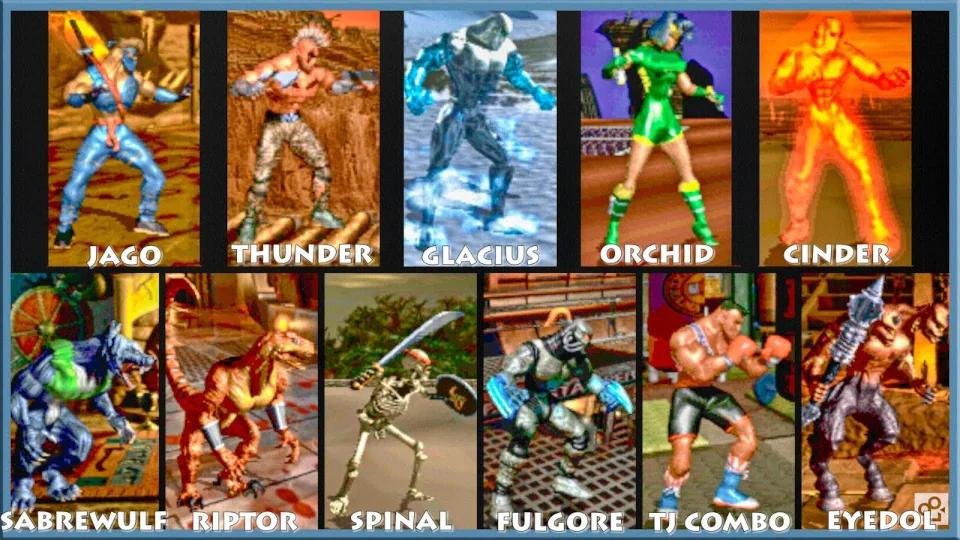
The original arcade game features ten standard fighters:
- Jago
- Black Orchid
- Chief Thunder
- TJ Combo
- Fulgore
- Glacius
- Sabrewulf
- Spinal
- Riptor
- Cinder
Eyedol serves as the boss. Whether and how he can be controlled depends on the version.
This is the lineup many players remember from the original arcade and Super Nintendo era. However, portable adaptations can differ, so identify your platform before following an old unlock guide.
Killer Instinct 2 Characters
Killer Instinct 2 retains seven standard fighters from the original game:
- Jago
- Orchid
- TJ Combo
- Fulgore
- Glacius
- Sabrewulf
- Spinal
It introduces three additional standard fighters:
- Maya
- Kim Wu
- Tusk
Gargos appears as the boss.
These changes explain why some classic roster lists include Maya and Tusk but omit Cinder, Riptor, and Thunder. Killer Instinct Gold is based on the sequel rather than the original game.
Frequently Asked Questions
Is Shadow Jago just a different costume for Jago?
No. Shadow Jago has a separate moveset in the modern game, including different movement and surge mechanics. Older information can be confusing because his playable design changed during the game’s development history.
Are Hisako and Shin Hisako separate characters?
Yes. They are separate roster selections with different weapons, mechanics, and strategies. Learning one does not automatically teach you how to play the other.
Which Killer Instinct characters are crossover guests?
The three crossover guests are Arbiter from Halo, Rash from Battletoads, and General RAAM from Gears of War.
Does Killer Instinct Anniversary Edition include every fighter?
The official website lists Anniversary Edition as including all 29 modern fighters. If purchased content appears unavailable, check the account you are using and whether the relevant content is installed.
Should beginners learn more than one character?
Experimenting is useful, but focusing on one character for a while makes recurring mistakes easier to identify. Consider adding a second fighter once you understand your main character’s basic strategy and difficult situations.
Are old Killer Instinct character guides still useful?
Older guides can explain terminology, general strategy, and character identity. Exact damage values, move properties, and rankings may depend on the update being discussed, so check detailed advice against your game version.
Who is the strongest Killer Instinct character?
There is no useful universal answer without specifying the game version, matchup, and level of play. Competitive strength and beginner suitability are also different questions. Choose a character whose strategy you understand and enjoy before worrying about rankings.
Conclusion
Choosing among Killer Instinct characters becomes easier when you focus on how you want to play. Start with a fighter whose basic strategy interests you, learn reliable defense, and practice one consistent way to turn an opening into damage.
Give yourself time to understand that character before switching because of a few losses. As your fundamentals improve, you will be better prepared to explore the roster’s more unusual mechanics—and recognize which fighter truly fits your style.